

-
Share on
-


Summary
- Sustainability requires evaluating the entire packaging lifecycle, including material choice, design efficiency, production processes, and end-of-life outcomes, to protect products, reduce environmental impact, and create business value.
- Laws such as EPR programs and single-use plastic bans, along with growing consumer demand for sustainable packaging, make compliance and transparency critical for companies pursuing sustainable practices.
- Corrugated packaging is durable, customizable, highly recyclable, and reusable, making it an ideal solution for businesses seeking to reduce waste, lower costs, and align with circular economy principles while enhancing brand experience.
Sustainable packaging is a frequent topic in business strategy discussions because it affects multiple business outcomes. Stakeholders push for environmental responsibility to protect brand reputation, meet ESG commitments, and reduce long-term risk. Meanwhile, operations teams require packaging to protect products, prevent damage, reduce returns, and maintain efficient supply chains. Finance teams, on the other hand, need to make sure that sustainability initiatives remain economically viable.
It’s common to simplify the solution by evaluating only material choice or recyclability claims. However, a single sustainability factor is insufficient to represent a packaging choice’s actual “sustainability”.
A more effective approach evaluates packaging throughout its entire lifecycle rather than focusing on a single feature. This perspective considers the sourcing of raw materials, the efficiency of the manufacturing process, and the packaging’s end-of-life outcomes.
Continue reading to understand these factors and learn how you can strengthen the business value of your packaging. This guide will help you answer the following questions:
Is Sustainable Packaging Economically Worth It?
Do the economic benefits of sustainable packaging outweigh the costs? Often, yes. But the answer depends on your products, supply chain, and how the packaging is implemented. Understanding these details can help you determine its real value for your business.
When we talk about sustainable packaging, we’re not just referring to materials that can be recycled or reused. Sustainable packaging should also be thoughtfully designed to serve its purpose, which is to protect and promote the product. The manufacturing process should be efficient, so you not only save on materials and production costs but also promote sustainability throughout the production.
To see exactly how sustainable packaging delivers economic value, let’s take a look at some factors that drive savings and efficiency in your supply chain.
1. Packaging Performance
High-performance linerboards, often made from layers of sturdy paperboard, sometimes blended with recycled fibers, can provide the strength needed to stack safely while using less material. Lighter boxes can reduce shipping costs and simplify handling, potentially saving money on transportation.
2. Cube Utilization
Unlike rigid or molded packaging, corrugated boxes can be sized to fit the product snugly and still provide plenty of protection. As a result, you can fit more boxes on a single pallet, which cuts down on the number of shipments you need to move the same amount of goods each year.
3. Material Consistency
High-quality recycled corrugated materials are made with a consistent structure, which allows automated case erectors and sealers to run efficiently at higher speeds. When the material stays consistent, machine jams and downtime caused by warped or poorly scored boards happen less often.
4. Material Recovery
Even after being used once, corrugated packaging retains considerable value, because Old Corrugated Containers (OCC) can be sent directly to paper mills for recycling. Implementing a baling program enables facilities to capture this value by selling the material back into the recycling stream.
What Sustainability Regulations Should I Be Aware Of?
According to Two Sides North America, 41% of consumers are willing to pay a premium for sustainably packaged products. Consumers are also moving past vague green claims and judging producers based on visible actions, according to PwC. Specifically, 40% of consumers evaluate sustainability based on how products are manufactured and recycled, while 38% look directly at the use of eco-friendly packaging. This is why manufacturers are investing in making not only their materials more sustainable but also their production processes more environmentally responsible.
At the same time, new sustainability regulations are guiding the shift toward a circular economy, where materials stay in use longer through sharing, leasing, reuse, repair, refurbishment, and recycling.
Extended Producer Responsibility (EPR) Laws
The Extended Producer Responsibility (EPR) Laws shift the responsibility for managing packaging waste from consumers and governments to producers, requiring manufacturers to fund and oversee recycling programs.
Several U.S. states have adopted EPR laws:
| State | Legislation and Effective Date | Requirements |
| Oregon | SB 582 | Producers of packaging, paper products, and food serviceware must fund and manage recycling. |
| Maine | LD 1541 | Producers pay fees based on packaging type and volume, reimbursing municipalities for recycling costs. |
| Colorado | HB22-1355 | Producers fund and manage recycling statewide and are accountable for the full lifecycle of their materials. |
To comply, it’s important to review your packaging’s lifecycle to reduce waste, make early material choices that lower long-term recycling costs, and collaborate with local recycling programs to ensure proper processing.
Single-Use Plastics Bans and Restrictions
States across the U.S. are phasing out single-use plastics because they often end up in landfills or waterways, and they are promoting sustainable alternatives like corrugated packaging.
-
California SB 54 phases out single-use plastics by 2032, encouraging recyclable and compostable materials.
-
New York bans most plastic carryout bags and promotes paper or reusable alternatives.
When choosing packaging, prioritize materials that are recyclable, reusable, or compostable. Corrugated board offers a sustainable option that can be customized to fit products efficiently while reducing environmental impact.
Recyclability and Compostability Standards
There is a growing push to make packaging part of a circular system, where materials are reused, recycled, or composted instead of discarded. New laws are setting stricter rules for how packaging should be designed, labeled, and managed at the end of its life.
To be considered recyclable, packaging must:
-
Be accepted by local recycling programs.
-
Be made from materials that can be remade into new products.
-
Be clearly labeled so consumers know how to recycle it.
Ensure regulatory compliance by using certified recyclable or compostable materials that are accepted in the states where your products circulate. Clear labeling and proper material selection can also help you maintain compliance with these standards.
Chemical and Toxicity Restrictions in Packaging
Toxic chemicals in packaging can pose risks to people and the environment. Regulations are increasingly targeting substances such as BPA and phthalates, particularly in food and consumer packaging, to keep hazardous materials out of the supply chain and protect both producers and consumers.
| Regulation | Scope |
| Toxic Substances Control Act (TSCA) | FDA Packaging Safety Regulations |
| State-Level PFAS Bans | Several states prohibit per- and polyfluoroalkyl substances (PFAS), often used in grease-resistant packaging, due to health concerns. |
| FDA Packaging Safety Regulations | Set limits on chemicals allowed in packaging that comes into contact with food. |
To ensure product safety, screen materials for restricted substances and use non-toxic or biodegradable alternatives whenever possible.
Carbon Footprint and Eco-Labeling Requirements
Federal and state programs now push for clear and accurate reporting of packaging emissions. California SB 343 requires companies to make truthful environmental claims and to disclose the carbon impact of packaging. At the federal level, Green Purchasing Programs favor packaging with lower environmental impact in government contracts.
Public companies also face new expectations. The SEC Climate Disclosure Rule requires reporting of carbon emissions tied to business activities, including packaging.
Follow the following practices to meet current carbon footprint reporting and eco labeling requirements and reduce your compliance risk.
-
Identify all packaging types and document the materials, weight, and suppliers used for each product.
-
Measure the carbon emissions linked to packaging using a recognized life cycle method and keep clear records of data sources and assumptions.
-
Review all environmental claims to make sure that they are accurate, specific, and supported by evidence.
-
Update packaging labels and marketing content so claims match your actual recycling practices and remove any statements that cannot be proven.
-
Make sure that packaging used for government sales meets federal purchasing requirements and keep supporting documentation available.
-
Include packaging emissions in climate disclosures for public reporting and ensure the data is consistent and reviewable.
-
Set up internal review steps so packaging data and environmental claims are checked and updated whenever materials or suppliers change.
Can Corrugated Packaging Support the Circular Economy?
The circular economy is guided by three core principles. First, design out waste and pollution by creating packaging that can be easily reused, recycled, or composted. Second, keep materials in use by extending their life through multiple cycles of reuse and recycling. Third, regenerate natural systems by relying on renewable resources and practicing responsible forestry management.
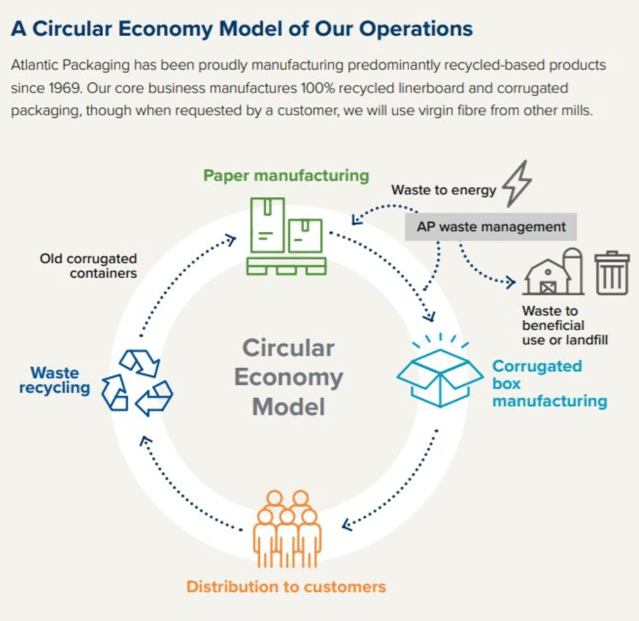
Atlantic Packaging’s Circular Economy Model
Brands can demonstrate their commitment to these principles through packaging. However, according to a 2024 report by the Plastic Overshoot Days initiative, packaging still accounts for a large share of the 220 million tons of plastic produced each year, which means that it is still a major driver of global plastic pollution.
One way to support the circular economy is to transition from plastic to corrugated packaging, which is made from fibers sourced from responsibly managed forests and recycled materials, and is fully recyclable and reusable.
-
Corrugated boxes move easily through closed-loop systems. In 2024, the U.S. recycled about 69% to 74% of old corrugated containers, consistently outperforming recovery rates for plastics and composite packaging.
-
Many companies reuse boxes for storage, returns, or reshipping before recycling. Each reuse cycle extends the fiber’s life, reduces waste, and increases environmental benefits.
However, sustainable outcomes also depend on thoughtful packaging design. You can use right-sized boxes to reduce fiber use, choose lighter structures to lower freight emissions, and limit inks and coatings to make recycling easier.
You can also guide consumers with clear labels and prompts to encourage reuse and proper recycling to keep sustainable packaging in the circular system longer.
How Is Corrugated Packaging Different from a Cardboard?
Many people use the term “cardboard” to describe any paper-based box, but cardboard and corrugated packaging are quite different.
Cardboard, or paperboard, works well for lightweight items like cereal boxes on store shelves. However, using the same material to ship fragile items, such as glassware across the country, would likely lead to damage and higher return rates.
Corrugated packaging, in contrast, is engineered to withstand the stresses of shipping, storage, and handling.
Cardboard vs. Corrugated Packaging
| Feature | Cardboard (Paperboard) | Corrugated Packaging |
| Structure | Single layer of thick paper | Multiple layers (liner–flute–liner) with internal fluting for strength |
| Protection | Provides basic protection but is not suitable for heavy or fragile items | Designed to resist compression, absorb impact, and protect products during shipping |
| Best Use Cases | Retail packaging, lightweight products, display boxes | Shipping, warehousing, heavy or fragile items, long‑distance transit |
| Stackability | Limited; prone to flattening under weight | High; fluted structure supports stacking without collapse |
| Customization | Smooth surface for detailed graphics and branding | Can be designed in various flute types and wall configurations for specific performance needs |
| Recyclability | Recyclable, but depends on coatings/laminates | Highly recyclable and often made with recycled content |
| Environmental Impact | Renewable and biodegradable, but less durable | Renewable, recyclable, supports circular systems more effectively |
| Durability vs. Weight | Lightweight, less durable | Strong yet lightweight, optimized for transport |
| Packaging Efficiency | Simpler use case; minimal structural engineering | Improves logistics by protecting goods, reducing damage and return costs |
How Can I Reuse Corrugated Packaging?
More and more, consumers understand that recycling by itself isn’t enough to tackle packaging waste. They are now looking for packaging that makes it easier to act sustainably in their daily routines. Repurposing boxes offers a simple and creative way to achieve this goal.
For businesses, repurposing adds a new dimension to brand engagement. When a corrugated box becomes a storage container, craft project, or pet accessory, you keep your brand visible in homes long after the original delivery. Below are some ways to repurpose corrugated packaging:
-
Home Storage and Organization – You can turn corrugated boxes into storage bins, drawer dividers, or desk organizers with minimal effort.
-
Gardening and Outdoor Uses – Line corrugated boxes to create seedling trays, biodegradable planters, or temporary garden beds.
-
Pet-Friendly Items – Large corrugated boxes can become play spaces, hideouts, or scratch boards for pets.
You can enhance reuse and recycling by designing corrugated packaging with durability and flexibility in mind. Use materials that hold up to multiple uses, avoid excessive coatings or inks that interfere with recyclability, and create standard sizes that are easy for consumers to store and repurpose.
Where Should I Source My Corrugated Packaging?
Is corrugated packaging economically worth it? Yes. Is it recyclable? Yes. Does it support the circular economy? Yes. Can I use corrugated packaging to elevate my brand and introduce our values to our customers? Yes.
But you can only achieve these advantages if you plan carefully, design your packaging for reuse and recyclability, and work with a packaging partner who shares your commitment to sustainability.
-
-
Work with a sustainable packaging partner instead of a supplier. Look for companies that go beyond selling materials and provide end‑to‑end packaging expertise, from design and material selection to lifecycle optimization and testing.
-
Choose suppliers with verified sustainable sourcing. Choose a corrugated packaging company that uses responsibly sourced and recycled materials. Vertically integrated companies that produce their own recycled containerboard can offer better quality control, stable supply, and verified environmental credentials.
-
Prioritize scalability and supply chain support. Your packaging partner should be able to deliver consistent quality at all volumes, whether you need small regional runs or large national shipments, and support growth without compromising sustainability goals.
-
Look for transparency and measurable sustainability results. Good suppliers provide tools such as lifecycle assessments (LCAs), sustainability scorecards, and data that track carbon footprint, recyclability, and ongoing improvement. This will help you measure and report progress to your stakeholders.
-
Lastly, choose a partner, like York Container Company that anticipates and comply with regulations. Sustainable packaging requirements continue to evolve. Source your packaging from a partner who understands the requirements and embeds them into their practices so your corrugated packaging remains sustainable and compliant even as regulations evolve.
Integrate Sustainability into Every Packaging Decision
Sustainable packaging works best when it is approached as an interconnected system, not just a material choice. Thoughtful material selection, efficient design, and careful end-of-life planning can protect products, reduce environmental impact, and create meaningful brand experiences all at once.
When you integrate these elements and work with suppliers who understand and support your goals, your packaging choice can ultimately become a lever for excellence operations and sustainability.
If you’re ready to achieve true sustainability through your packaging, partner with York Container today!