

-
Share on
-


Summary
- Many businesses look at the price per roll or bag when budgeting for protective packaging materials. However, this only reflects what you pay for the supply itself. It does not account for your labor costs, storage needs, damage rates, and shipping expenses.
- Cheaper packaging supplies are not always cost-effective. To make the most of your investment, make sure to account for what your product actually needs and what your operations require.
- It’s vital to view your packaging strategy through a holistic lens to build a lean, efficient, and profitable operation.
_______________________________________________________________________
Businesses worldwide are pouring money into protective packaging, with the market set to reach $44.5 billion by 2028 at a CAGR of 5.9%. But despite this amount of investment, damage rates during shipping remain a persistent problem for businesses of all sizes.
It’s not that companies don’t account for protection in their packaging strategy. The numbers prove that they actually do. However, many businesses still treat protective packaging supplies as a fixed and unavoidable expense rather than a decision worth optimizing.
That said, your protective packaging materials deserve a little more scrutiny in terms of how they drive your costs and how they affect your products and operations.
Commonly Missed Factors When Budgeting for Protective Packaging Supplies
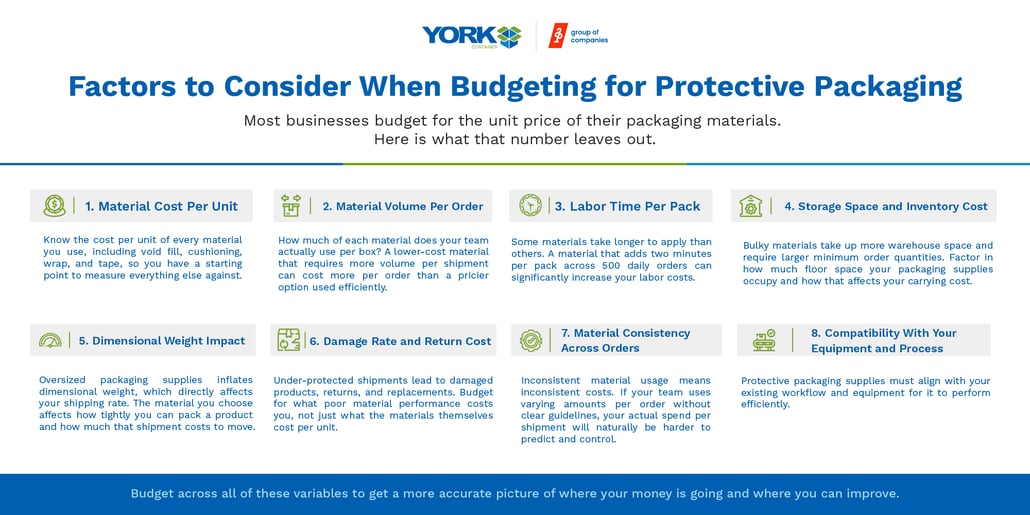
Protective Packaging Supply Budgeting Guide
A single product shipment involves more cost variables than most businesses track closely: the packaging supply itself, the labor time to fill and seal the corrugated packaging, the storage space materials occupy, and the dimensional weight of the finished package.
Many businesses do not fully account for at least one of these variables. One of the most common culprits is the material itself.
Inappropriate Material Can Cost You More Per Box Than You Realize
Your material choice affects how much packing material your packers use per box. A dense and heavy item protected by crumpled kraft paper, for instance, requires significantly more volume to secure your product during transit. But if you pack the same item with a properly sized foam insert or air cushion, you will use less material and finish the process in less time.
Cheap Is Not Always Cost-Effective
Choosing a cheaper packaging supply that requires two to three times the volume to do the job will often cost more per shipment than a slightly more expensive option used efficiently.
For example, a loose fill at $0.10 per unit, requiring 12 units per box, costs $1.20 per order. But if you use an alternative that costs $0.18 per unit and requires five units, each of your orders will only cost $0.90 and save you $0.30 per order.
This totals $150 per day for 500 shipments before accounting for the difference in the time required to pack each order.
Packaging Supplies are Part of a Holistic Packaging Strategy
Last but not least, you should always treat your protective packaging as a key component that affects everything else in your packaging process.
You can better control your costs and make your process more efficient by planning your packaging supplies around how you need them to protect your products and how they perform alongside the rest of your packaging strategy. Consider whether the material meets your product requirements and fits well with your existing equipment and processes.
Rethink Your Packaging Supply Strategy to Protect Your Margin
Define Protection Requirements Per Product
Each product you ship has a specific weight, fragility level, and movement pattern during transit. A ceramic item, for example, needs different protection than a metal component.
You can set clear standards for cushioning depth, void-fill amount, and sealing method for each product type so your packing team follows a defined process rather than making decisions on the spot.
Standardize Your Material Usage
Without packaging guidelines, your material usage will vary depending on who packs the order and how they perceive a particular item. To reduce variation between orders, set consistent ranges for how much void-fill, cushioning, or wrap each product category should receive. Setting an initial guideline should also give you a baseline you can actually measure and improve.
Measure Your Packaging Supply Performance Regularly
York Container is a firm believer that good packaging decisions come from reliable data. To truly improve your packaging’s performance and reduce unnecessary costs, you need clear visibility into how your packaging, in all its elements, including the corrugated packaging itself, the packaging design, the fill, and the process, actually performs.
Monitor your damage rate after delivery. If it continues to rise, your current protection level may not be enough for certain products or shipping routes.
It is also equally important to track your material usage per order. If usage is inconsistent or increasing without a clear reason, your packing process likely lacks clear standards.
Upgrade Your Packaging Supplies Before Your Next Shipping Cycle
Your protective packaging deserves a much closer look in your strategy. If you shift from simply buying supplies to deliberately planning how they are used, it gives you more control over your margins, your warehouse throughput, and your customers’ experience when they open their packages.
At York Container Company, our experts evaluate every strategy against these three core priorities to make sure that your operations are as lean and effective as possible:
- Presentation. Customers judge product quality the moment they open a package. How your products arrive at their doorstep shapes their perception of your brand, impacts return rates, and influences whether they buy from you again or not.
- Performance. Packaging directly affects how smoothly your facility operates. Materials that are difficult to handle or take longer to install tend to extend handling time and raise labor costs per order.
- Protection. You need to understand the role of each supply in your products and your supply chain to improve product protection at every stage of the distribution network.
If your process is driving higher damage rates or uneven material use, reach out to York Container Company to schedule a site assessment. You can also connect with SkyBox Packaging and Champion Container to explore solutions built for manufacturing and distribution.
Frequently Asked Questions
Q: If I spend more on high-quality protective materials, won't my total costs increase?
A: Not necessarily. While the price per unit of premium materials might be higher than bulk paper or loose fill, you often use significantly less of them. As shown in our example, using fewer units of a more effective material can actually save you $0.30 or more per order, while also reducing the labor time required to pack the box.
Q: How do I know if I am over-packaging my products?
A: Over-packaging is usually signaled by two things. First, high shipping costs due to excessive dimensional (DIM) weight. Second, negative customer feedback about excessive waste. If your boxes are significantly larger than the product inside to accommodate large amounts of void-fill, you are likely paying a penalty to your carrier that could be reduced with a more optimized packaging design.
Q: Why is standardization so important if my products come in different sizes?
A: Without clear standards, your team is forced to make guesswork decisions under pressure. However, if you categorize your products and set specific protection profiles, such as Category A gets 2 inches of wrap, you create a repeatable process that can stabilize your material spend and support a more consistent customer experience.