


-
Share on
-


Summary
- Your e-commerce packaging supplies affect more parts of your operation than you might anticipate, from what carriers bill you per shipment to how smoothly your team moves through a busy fulfillment day.
- Small choices such as padding thickness and insert design have a direct impact on your dimensional weight, which also affects what you pay to ship every order.
- Consider these five factors to help you evaluate your e-commerce packaging supplies and materials so every decision you make supports your products, your team, and your customers at the same time.
You have put a lot of thought into your packaging materials. You have the right boxes, plenty of tape, and plenty of bubble wrap. So why rethink your approach at all?
If you are reading this blog, you already understand that packaging supplies are not only there to protect your products. They also influence how customers feel when they open their order, how quickly your team moves through fulfillment, whether your compliance requirements are met, and how much you spend beyond the cost of each item.
To improve your strategy for your customers, your team, and your bottom line, this guide is a good place to start.
5 Factors to Consider When Selecting E-commerce Packaging Supplies
1. Performance Under Stress
Did you know? Returns are a consistent source of margin pressure in e-commerce. In the first quarter of 2026, about 19 to 20.5 % of orders were returned, roughly two to three times higher than brick and mortar retail.
It’s not so surprising that a meaningful share of these returns is linked to packaging that did not withstand the rigors of shipping. That is why everything, from the box to your packing setup, should be tested before it reaches the shipping stage.
At York Container and Atlantic Packaging, we ensure that each component of our packaging supplies, including both the contents and the surrounding materials, is tested within our ISTA certified testing lab in accordance with your product, transit, and industry requirements. To achieve this, we conduct:
- Vibration Test (ISTA 1A, 1B)- Simulates distribution movement. It reveals settling or shifting in void fill materials like paper, air pillows, or packing peanuts and tests tape adhesion under repeated flexing of carton flaps.
- Free Drop Test (ISTA 1A)- Simulates impact damage from drops and handling. It evaluates corner and surface protection, cushioning performance, and tape strength under sudden shock and internal pressure.
- Incline Test (ISTA 1B)- Simulates lateral impact on heavier shipments. It assesses the strength of blocking and bracing materials like foam or corrugated inserts under forceful side movement.
2. Durability and Easy Access
A standard domestic package passes through an average of 7 to 10 distinct touchpoints from the moment it leaves the warehouse shelf to the moment it reaches your customer’s doorstep. Your protective packaging supplies must be strong enough to withstand repeated handling, stacking, and scanning throughout this journey.
However, there is a fine line between security and overpacking. When customers need to fight through heavy tape and plastic just to open a package, their unboxing can quickly turn into a negative impression of your brand.
To balance product protection with material use and customer experience, look for protective supplies that offer a high strength-to-weight ratio. This means the material, whether it is a specialized paper wrap or a custom insert, can absorb significant impact or resist tearing despite being lightweight.
3. Control Over Shipment Size
Did you know? U.S. online retailers collectively spend over $100 billion on shipping each year, with transport expenses forming the largest portion of a $150 billion plus logistics market. Typical costs fall between $7.96 per parcel and 10 to 15 percent of net sales.
Carriers bill based on dimensional weight (DIM), which means that a lack of precision on your packing line can cause you to pay a premium to ship empty space.
To identify the DIM of your package, multiply the three dimensions of your package and divide that total by the carrier divisor. Calculate the volume in inches and divide by a specific number set by your shipping company.
Dimensional Weight (DIM) =Length x Width x HeightDivisor
Then round any decimal up to the next whole pound. UPS and FedEx usually use a divisor of 139 for standard daily rates. USPS typically uses 166 for most domestic parcels. The key idea is that a smaller divisor results in a higher dimensional weight, which can increase shipping costs. So, always check the exact divisor with your carrier since it can change depending on the service level.
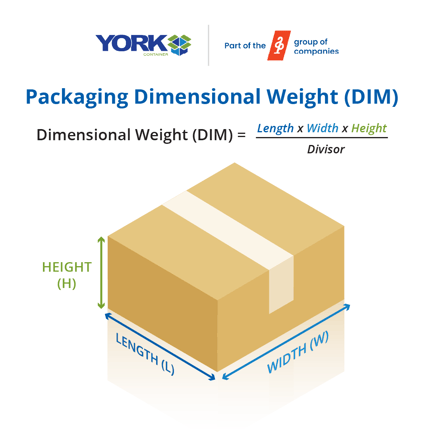
Dimensional Weight (DIM) formula
You must evaluate your packaging materials regularly to ensure they do not artificially increase your shipping volume.
✔️ Measure padding thickness- Check if your protective liners exceed half an inch. Thicker foam or bubble layers often require larger boxes and increase dimensional weight.
✔️ Assess void fill compression- Review how materials compress under pressure. Non compressible fillers can require bigger corrugated boxes, while molded trays can reduce extra space.
✔️ Check internal gaps in inserts- Look for unused hollow space inside insert designs. Removing these areas can help you reduce your overall package size.
✔️ Evaluate insert consistency- Match inserts to your product’s size to avoid oversized packaging.
✔️ Review material weight and volume- Check if materials add bulk without added strength. Switching to flatter structural designs can reduce empty space inside the package.
4. Contribution to Circularity
True circularity goes beyond using materials with a recyclable label. It depends on what actually happens to materials in the waste system. A material is only circular when there are systems in place to collect it and turn it into something new. Without a clear recovery path, even well-intentioned packaging becomes single-use waste.
To help your customers, focus on reducing the friction of disposal on their end. You want to provide the customer with steps for every supply used around and inside the corrugated packaging, regardless of whether it is paper, plastic, or a composite.
- If the paper material is not dirty or wet, place it in paper recycling instead of throwing it away as general waste.
- Separate plastic based fills and check local recycling rules before disposal.
- State limited recovery options for composite materials so customers know what to expect.
5. Fulfillment Throughput
Packaging supplies are easy to overlook when evaluating fulfillment speed. But the materials your team handles dozens or hundreds of times a day can significantly affect how much they can get done, and how consistently they can do it.
To make your inventory management and fulfillment more efficient, make sure your supplies are compatible with how your operation runs and can keep up as you scale.
- Do they fit your products in size, protection, and handling requirements?
- Do they match your current workflow?
- Can your process stay consistent during busy periods?
You can also consider whether upgrading or adding equipment along with your new packaging supplies to improve your speed and consistency.
The Best E-commerce Packaging Supplies Make Every Part of Your Operation Run Better
Of course, optimizing your e-commerce packaging does not end with a one-time decision. It is an ongoing process where materials, environment, and labor should work together.
When looking for new packaging supplies, focus on how well they match your infrastructure and workflow. Your supplies should support your current pace and still perform well as your order volume grows.
If you notice inconsistent seal strength, rising costs, or delays on your packing line, it may be time to rethink your approach. Reach out to our packaging specialists to review your current material performance or explore our full range of packaging solutions!
E-Commerce Packaging Supply FAQs
If carriers update their DIM divisors, how do I know when my current packaging is costing me more than it should? +
My products vary a lot in size. Is it realistic to optimize packaging for dimensional weight without having a different box for every SKU? +