

-
Share on
-


Summary
- Many packaging bottlenecks stem from supply specifications that are not aligned with your product handling and transit requirements.
- Inappropriate packaging supplies may still protect your products to some extent, but they can lead to excess material use and process inefficiencies.
- To maximize the value of your packaging supplies, you need a sourcing strategy that accounts for both your product requirements and the realities of your operation.
Shipping damage is still one of the most expensive and preventable problems for manufacturers and distributors. In 2024 alone, 85 million packages arrived damaged, a 30% increase from the year before. This upward trend carried into 2025, contributing to about $4 billion in industry-wide losses.
While transit handling is often the first point of blame, packaging inputs such as tape, stretch fill, and cushioning play a bigger role in both damage rates and overall packaging spend than most operations account for.
The good news is that because packaging supplies play such a significant role in your packaging strategy, they're also one of the most impactful places to start and one of the more manageable variables to optimize.
So, how impactful are your packaging supplies in your operations, really? And how do you evaluate your choices when you are ready to make a purchasing decision?
Let's begin with these three core questions:
- What are the most common types of commercial packaging supplies?
- What factors should you consider when sourcing your packaging supplies?
Your Choice of Packaging Supplies Can Influence Your Margin
Packaging supplies are rarely evaluated against the complete cost they generate. Many teams track what they spend on materials, but the downstream costs, such as freight claims, product replacements, rework, and labor inefficiencies, are usually sitting in separate budget lines with no clear connection to the packaging decision that caused them.
A more accurate picture of packaging supply costs includes the unit cost of the material, how much of it gets used per shipment, how it performs under your actual shipping conditions, and what happens operationally when it doesn't perform as expected. It also has to account for how your supplies interact with the rest of your packaging strategy.
A good starting point to identify packaging cost drivers is to calculate the Total Cost of Ownership (TCO) of your packaging supplies. From there, you can identify delays in your packaging process, measure the true cost of shipping-related damage or waste, and identify where you can reduce labor touch points.
Most Common Types of Commercial Packaging Supplies
With your audit complete, take a closer look at the materials you used and whatever they fit each use case. Here are the most common commercial packaging supply types:
Packaging Supplies for Protection and Cushioning
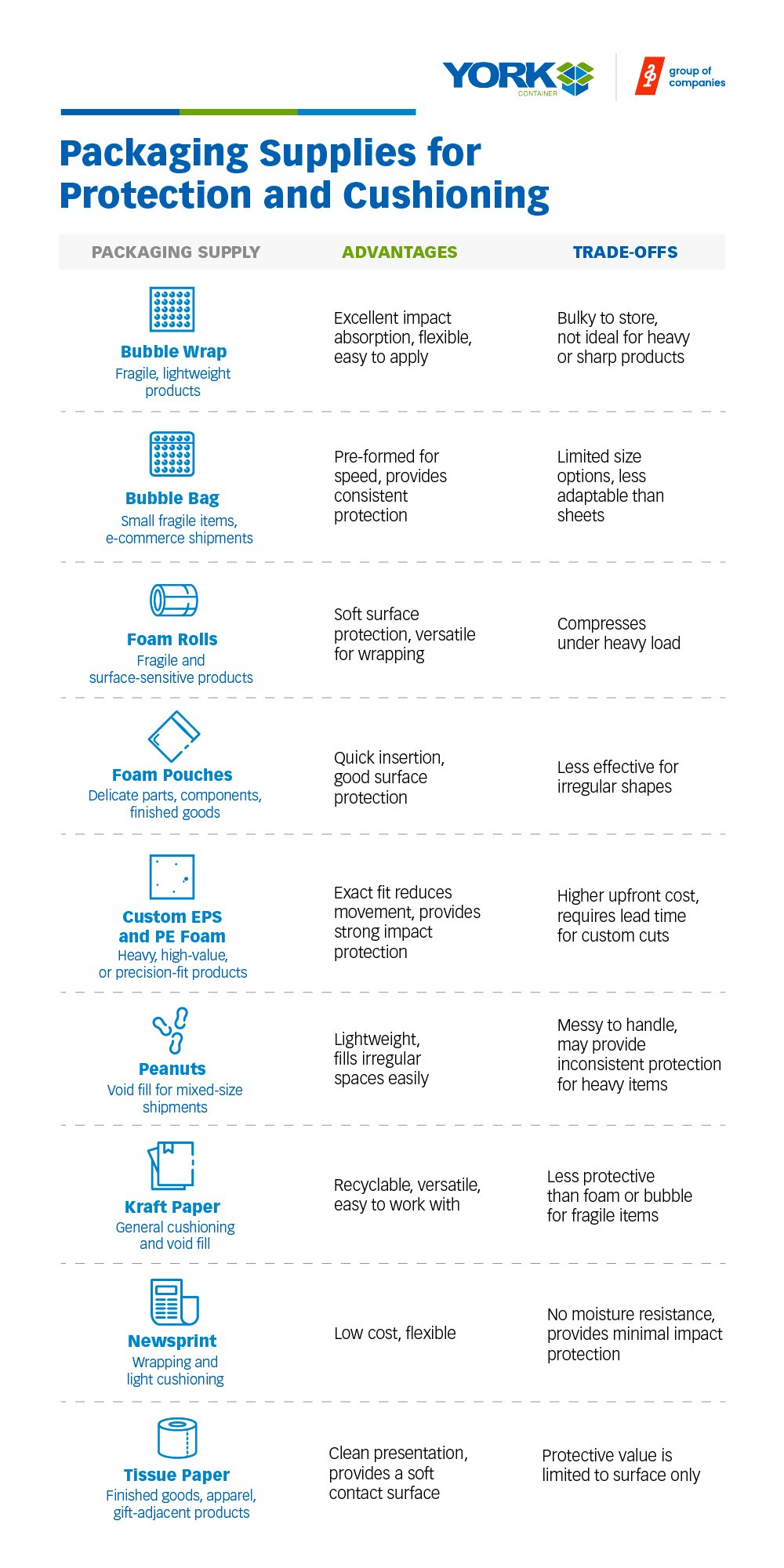
Packaging Supplies for Protection and Cushioning
Packaging Supplies for Containment
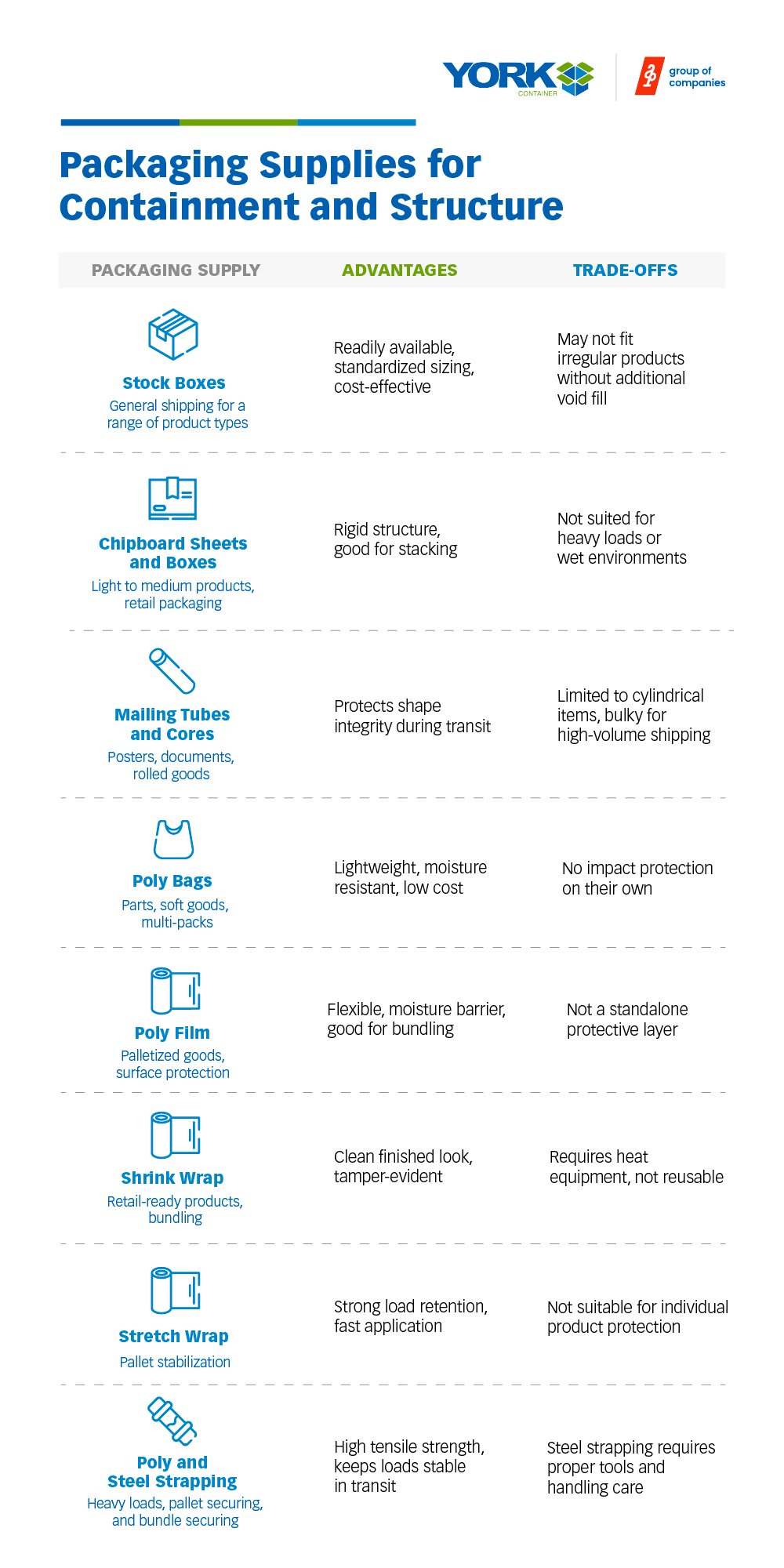
Packaging Supplies for Containment
Packaging Supplies for Labeling and Identification
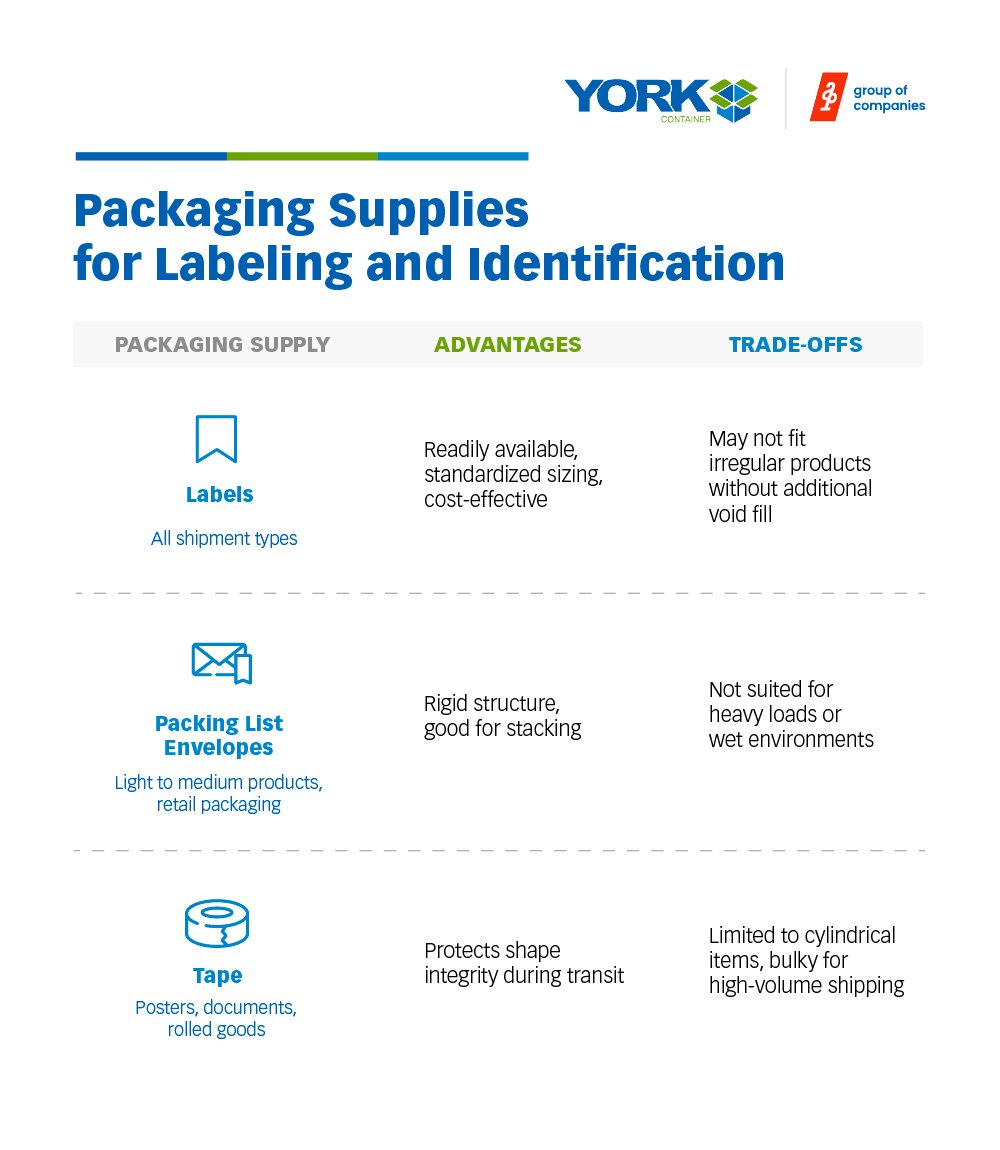
Packaging Supplies for Labeling and Identification
Common Types of Packaging Supplies by Industry
Food and Beverage Packaging Supplies
The food and beverage industry is one of the strictest industries when it comes to packaging. Packaging that touches food must comply with government regulations such as FDA food contact rules under Title 21 of the Code of Federal Regulations.
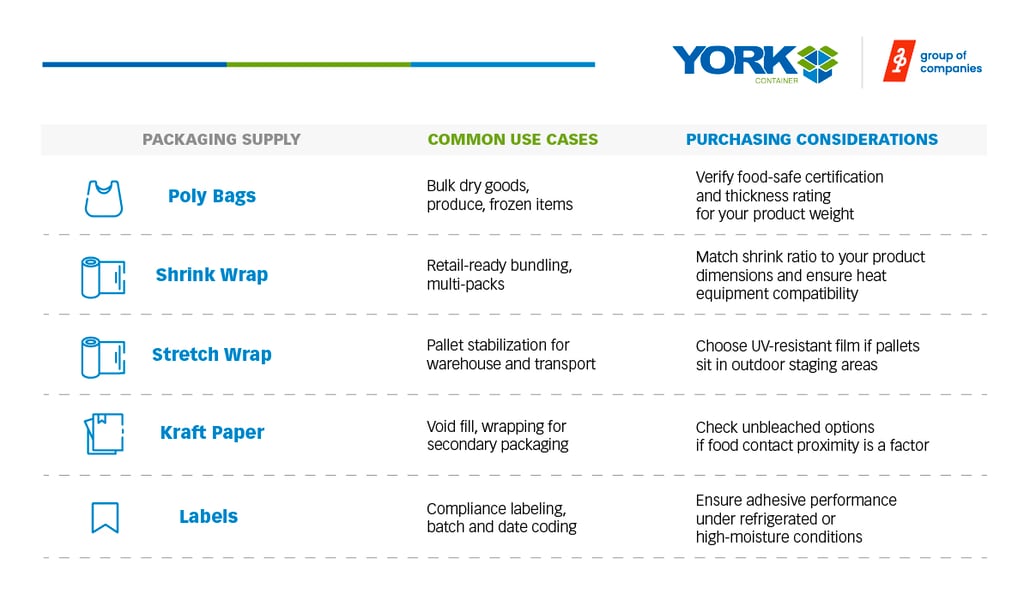
Food and Beverage Packaging Supplies
Tip: Prioritize food-safe certified materials and require suppliers to provide documentation on request. Test material performance under temperature variation before committing to high-volume orders.
Retail Packaging Supplies
Your retail packaging strategy should serve two functions at once. First, it should protect the product as it moves through the supply chain. Second, it should present the product clearly at the point of sale.
For companies that make products for stores and supermarkets, consistent product presentation on the shelf matters just as much as protecting items during transit.
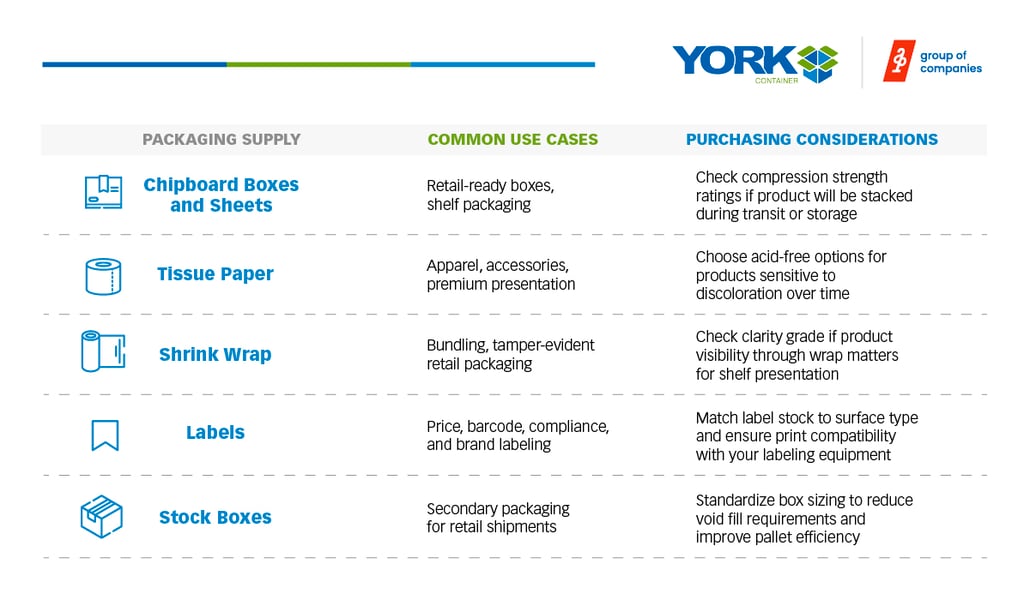
Retail Packaging Supplies
Tip: Retailer compliance requirements around labeling, barcoding, and packaging dimensions vary widely. Build those specifications into your purchasing criteria before selecting materials instead of accounting for them later in the process.
E-commerce Packaging Supplies
Shipments in e-commerce move through handling points than most other distribution models. Customers also receive the packaging exactly as it arrives, which means that you need to plan for both protection and presentation in your packaging strategy.
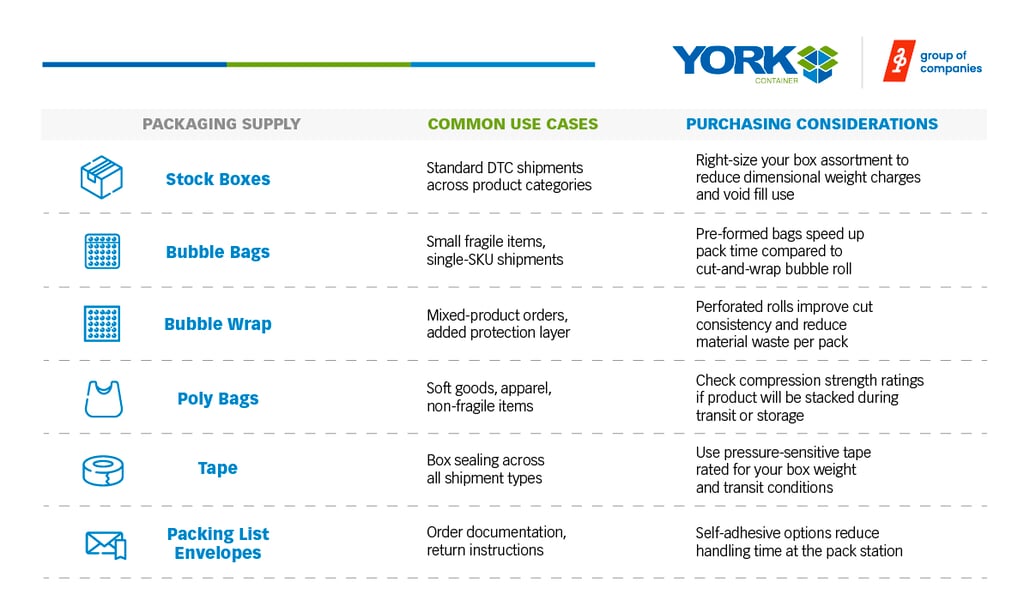
E-commerce Packaging Supplies
Tip: Carrier pricing based on dimensional weight makes your choice of packing supplies one of the most important decisions in e-commerce packaging. Before you standardized your assortment of fills, inserts, and boxes, map your most common product sizes and weights agains your carrier's pricing model.
Electronics and Technology Packaging Supplies
Electronics need protection from physical shock and electrostatic discharge, which are not as common for most other products.
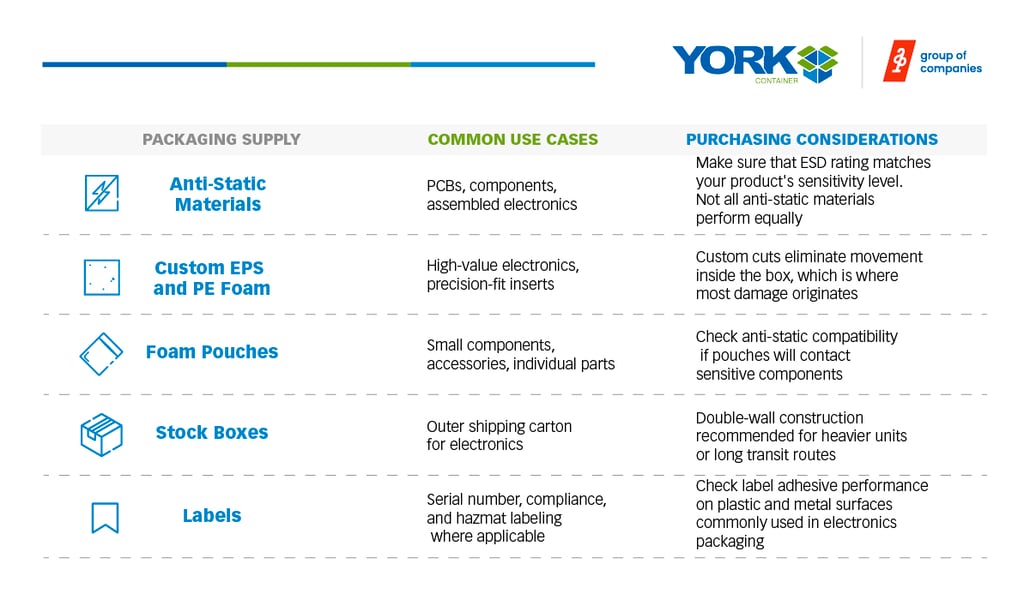
Electronics and Technology Packaging Supplies
Tip: When you choose anti-static supplies such as fills and tapes, involve your engineering or quality team, not just procurement. A material can look suitable on the surface but still create static risks that appear during handling or transport.
Pharmaceutical and Healthcare Packaging Supplies
Pharmaceutical and healthcare packaging follows even stricter requirements than food and beverage packaging. You need materials that meet regulatory standards while protecting product integrity through storage and transit.
In many cases, your packaging supplies should also support clear tracking through labeling and identification for chain of custody.
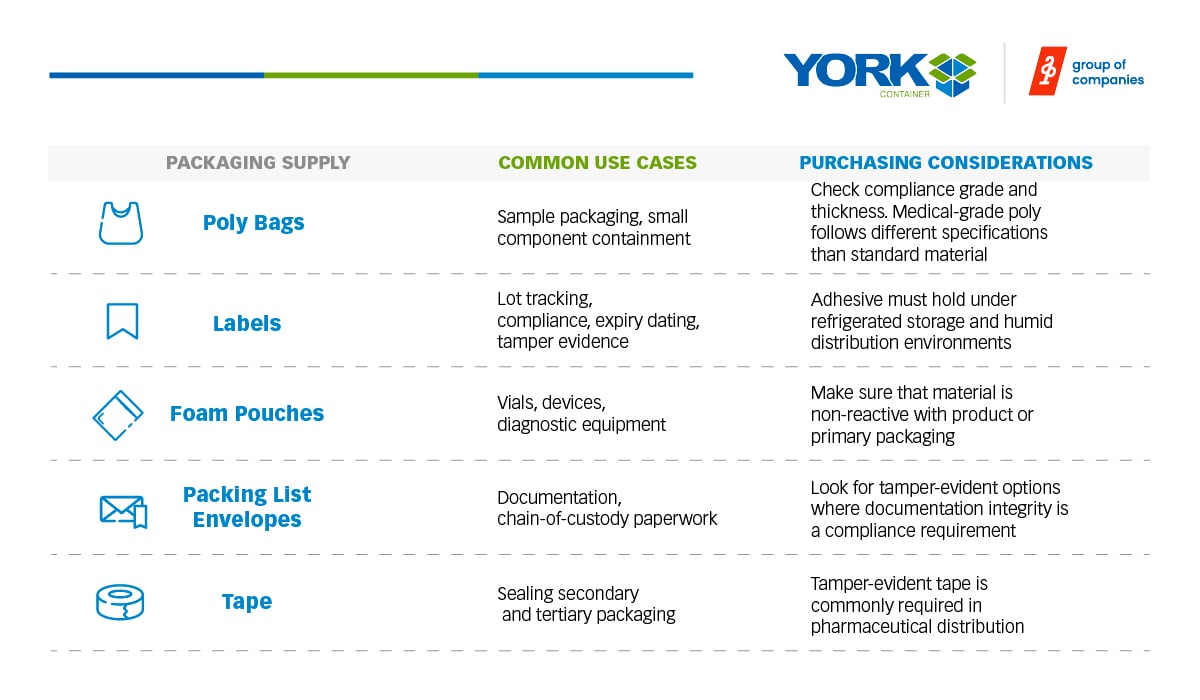
Pharmaceutical and Healthcare Packaging Supplies
Tip: Before committing to a supplier, make sure that they can provide specification sheets, compliance certifications, and traceability records consistently.
Industrial and Heavy Manufacturing Packaging Supplies
Finally, when you handle dense, abrasive, or irregular products that move on pallets through long or demanding transit routes, you need to prioritize load stability first, along with protection agains corrosion and damage. In this case, presentation matters less than it does in consumer-facing industries.
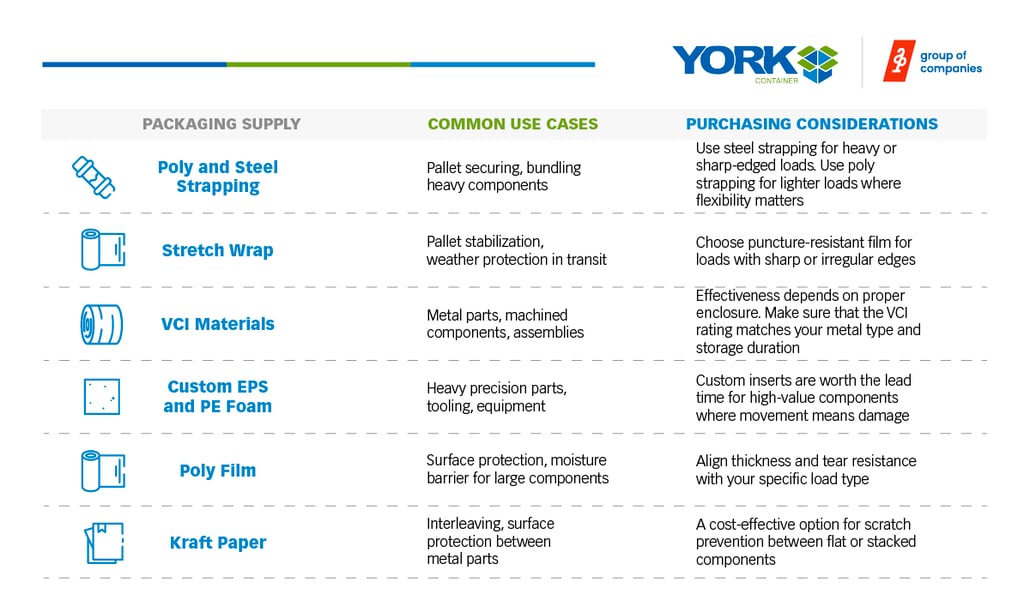
Industrial and Heavy Manufacturing Packaging Supplies
Tip: Before you standardized pallet setups, strapping systems, or stabilizing supplies, test them under realistic transit conditions or review carrier damage data from your existing shipments.
Important Considerations Before Sourcing Your Packaging Supplies
Choosing packaging supplies effectively means knowing what questions to ask before price enters your conversation with the supplier. As established in the previous sections, the right material for your operation depends on your product's physical requirements, your supply chain conditions, your compliance obligations, and your supplier's ability to perform at scale.
Consider these factors to make your supplier list much shorter and more qualified.
| What You Should Evaluate | Questions You Should Ask |
| Define Product Requirements | Have you clearly defined your constraints before selecting your packaging supplies? |
| Assess Load Integrity and Handling Risks | What protection levels do your products need during handling, stacking, and transit? How do your fills, inserts, or cushioning materials meet those needs? |
| Map Your Distribution Environment | Have you mapped the full shipment journey, including storage, handling, and environmental exposure? |
| Validate In-Transit Performance | Have you tested your packaging supplies under actual distribution conditions? |
| Align with Regulatory and Specification Requirements | What mandatory requirements apply to your products? Do you pre-qualify packaging supplies before sourcing? |
| Account for Channel and Market Variability | Do you maintain consistent packaging specifications across regions and channels? Can your supplier meet the required standards for each variation? |
| Evaluate Total Landed Cost | Do your sourcing decisions reflect total cost impact, including damage, returns, rework, and handling, or are they still driven mainly by unit price? |
| Review Loss and Claims Data | What does your historical damage and claims data show? |
| Assess Supplier Performance | How consistently does your supplier meet fill rates, lead times, and quality standards during peak demand and volume spikes? |
| Assess Scale Readiness | Can your supplier support growing order volumes without lowering service levels, material consistency, or lead times? |
Most importantly, you should think of packaging as a system. Your packaging supplies should match your packaging and the equipment you use. A stretch film that performs well on its own may work poorly if it does not match your wrapping machine's tension settings. A tape that holds well in ambient conditions may lose adhesion if your corrugated boxes are cold from refriderated storage. Even the right void fill can become a poor choice if it does not dispense efficiently on your line.
Before finalizing any sourcing decision, map out how each packaging supply interacts with the rest of your packaging system. Better yet, bring your equipment specifications during the conversation with your supplier.
Move From Cost-Driven to Efficiency-Driven Packaging Supply Decisions
Cost and availability will always play a role in your packaging decision. However, you can maximize the value of your packaging supplies and reduce costs if you take a few steps back from pricing conversations and evaluate whether your supplies are aligned with how your operations runs and what your packaging is ultimately meant to do.
At York Container, we view every part of packaging strategy, including packaging and packaging supplies, against these three core pillars:
- Presentation. Customers naturally judge your product quality by how it arrives. Your choice of packaging supplies affects how products look and hold up on arrival, which can influence returns, replacements, and customer satisfaction.
- Performance. Your packaging supplies must always support efficient movement through your facility. If materials hinder your packing process, require extra handling or create inconsistency between operator, they can significantly albeit silently, increase your labor time and reduce throughput, which ultimately increases your total landed cost and reduces your margin.
- Protection. It is one thing to protect your product. It is another to do it efficiently. Packaging supplies may be among the least expensive parts of your supply chain, but they can become costly to manage without a clear strategy.
If you are looking to strengthen your strategy, our packaging supply experts at US companies in the Atlantic Packaging Group, including SkyBox Packaging and Champion Container, and of course, us at York Container, can help you select solutions to achieve better performance, consistency, and scale. Contact our team today!
Packaging Supply FAQs
Q: How do I switch to a new packaging supply material without affecting my production?
A: A good way to do this is to test it in a small and controlled area first. Select one high-volume product or one shipping route and use the new material there. This lets you see how the new packaging supply will perform in actual conditions and get feedback from the packing team before rolling it out everywhere.
Q: If my damage rates are low, does it mean I am using too many packaging supplies?
A: That can be the case. Very low damage rates may mean you are using more material than you need. You can test lighter packaging supplies on a small batch and compare the results. If damage levels stay the same, you may be able to reduce material use and lower costs.
Q: How can I tell if a packaging supplier is the right fit for my product and operations?
A: To find the right packaging supplier, you must make sure that their technical capabilities align with your operational scale. A truly compatible partner offers a transparent pricing structure, maintains high sustainability standards, and demonstrates proactive communication by identifying risks before they reach production. Ultimately, the best fit is a supplier that treats your business like a partner.